The word school carries decades of assumptions — bells, rows, compliance, credentials. We are building something different. Here is what it actually looks like, and why it matters deeply.
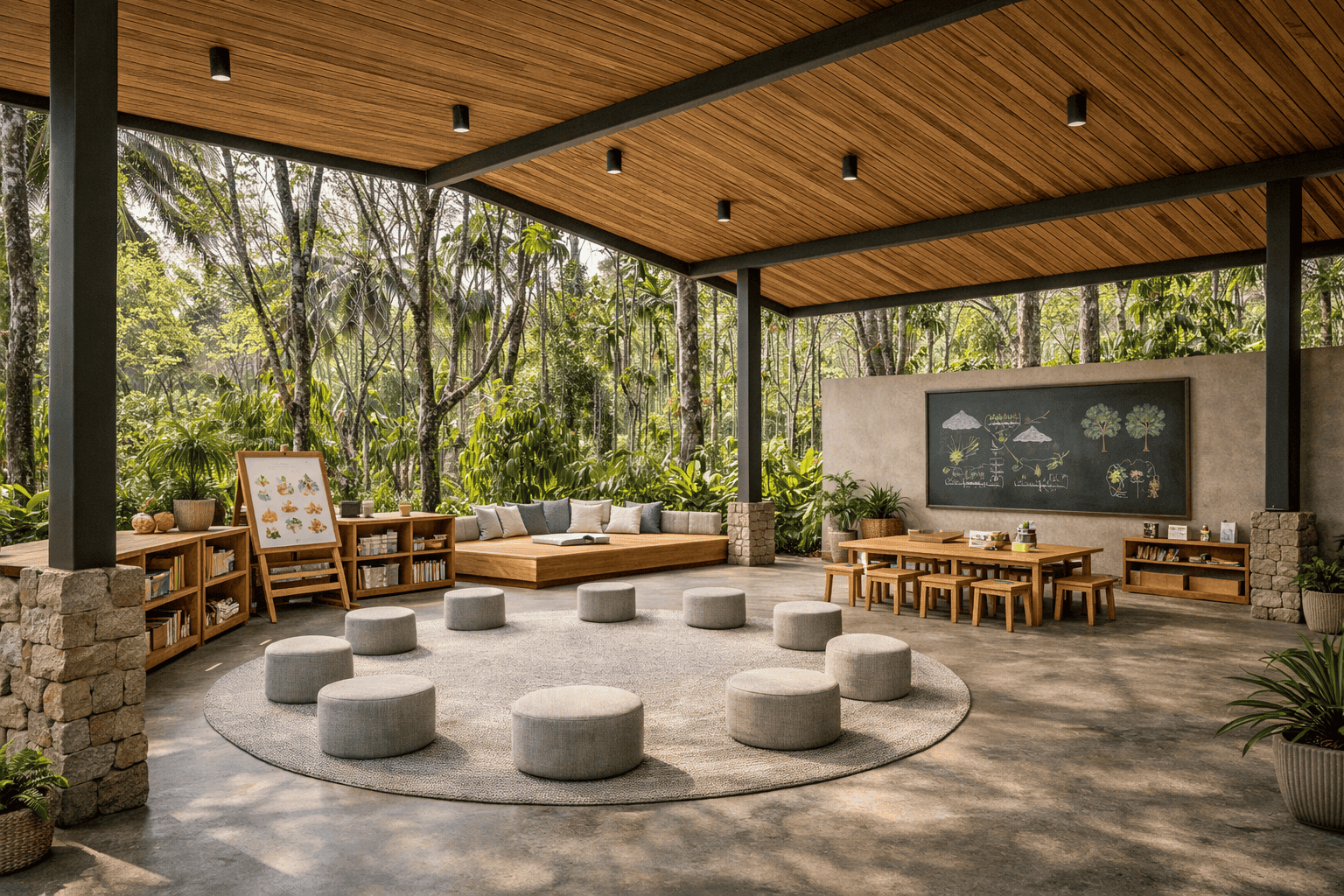
We deliberately chose not to call it a school. Not because learning is unimportant — it is the most important thing we do for our children. But because the word carries assumptions this place is designed to question.
The modern school optimises for compliance — sitting still, following instructions, reproducing information in the format the assessment requires. It produces children who are good at school. It produces children who are good at school. But not always children who are capable, curious, grounded, or self-directed.
The most thoughtful alternative learning communities treat the land itself as the curriculum. Children learn mathematics by measuring fields, science by observing crops, responsibility by tending things that suffer when neglected. The classroom is the world.
This does not mean children spend all day outside without structure. It means learning stays connected to reality — to seasons, to materials, to people, and to consequences. A child who has watched a seedling struggle through poor soil understands something about patience and conditions that no textbook can fully convey.
We want children who know how to think, not just what to think. Rooted in faith, land, and community before credentials become the centre of their identity.
Like a seed, a child does not grow because someone pulls on it. Growth emerges when the conditions are right. We see education not simply as the transfer of information, but as the cultivation of an environment where curiosity, competence, responsibility, and character can flourish.
This is not a critique of conventional schooling. It is simply a different answer to a different question — not how do we prepare children for the world as it is, but how do we raise children who are capable of building a better one.
Yes — children from this Learning Centre can enter university if they choose to. Recognised frameworks including Cambridge IGCSE and the International Baccalaureate are available to homeschooled students. Many universities actively welcome candidates from non-conventional educational backgrounds.
But the deeper point is this: a child who can read deeply, write clearly, think carefully, and carry responsibility will be well prepared for whatever path they choose — university included. The credential question is downstream of the character question. We are focused on the character question.
The Learning Centre is still being shaped. Its structure will emerge through the founding families and the education stewardship they build together. If education is your area — your voice in shaping this is one of the most valuable things the Seed Circle offers.
If the question of your children's education is at the centre of your thinking — it should be. Let's talk about what we are building and how you can help shape it.
Message us on WhatsApp Register your roots