Enough land knowledge. Enough practical skill. Enough time. Enough energy. Enough certainty.
The image people often carry of community life is strangely uniform — everyone farming together, building together, contributing in the same visible ways. A life where value is measured mainly through physical labour.
That is not what we are building.
The village has always contained many kinds of people
A healthy community has never depended on everyone doing the same work. It depends on people remaining committed to a shared life while contributing differently across seasons, capacities, and roles.
- The farmer
- The teacher
- The carpenter
- The grandmother
- The healer
- The organiser
- The child
- The scholar
- The cook
- The person who simply shows up consistently when someone else is struggling
None of these roles stand outside community life. All of them sustain it.
What contribution is not
Contribution does not mean every resident farms daily. It does not mean everyone builds with earth by hand. It does not mean every family joins every project, every meeting, every harvest.
The collective is not built on the idea of identical labour.
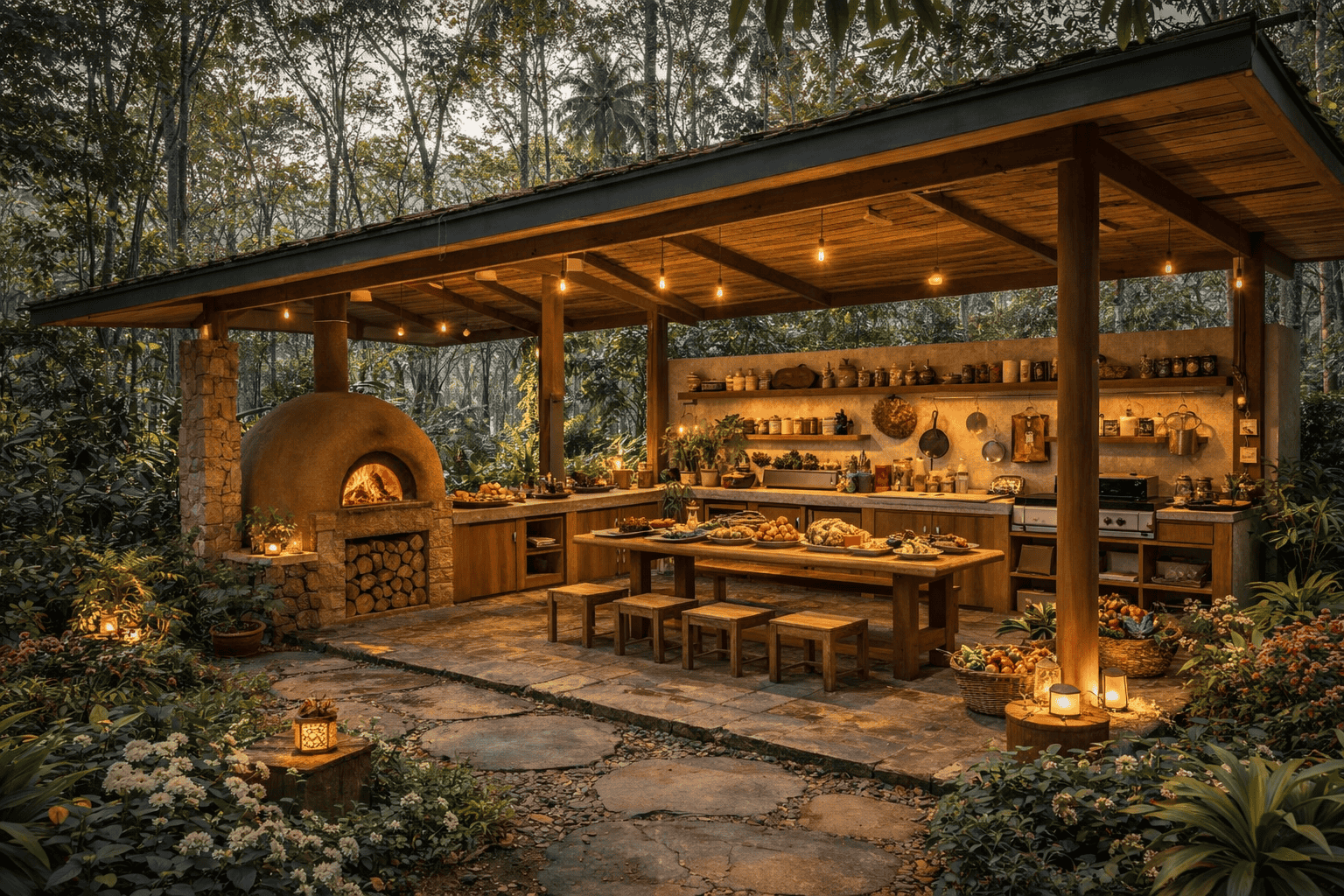
Some members may spend mornings tending nursery beds while others continue remote work from the co-work barn. One family may help shape the Learning Centre curriculum. Another may quietly support the governance and financial systems that allow the entire place to function. An elderly couple may no longer carry heavy loads but still become anchors of presence, wisdom, and continuity within the social life of the community.
The measure is not sameness. It is participation in the shared life of the place.
The larger systems — the farm, hospitality operations, ecological restoration, infrastructure — will rely not only on residents, but also on skilled practitioners, local workers, craftspeople, and specialist stewards whose knowledge and consistency make long-term stewardship possible. This is not a failure of community. It is how real communities have always worked.
Different seasons of life
A young family with three small children contributes differently than a retired builder. Someone recovering from burnout contributes differently than someone arriving with abundant energy and capacity. A person deeply involved in governance one year may step back the next.
Communities become resilient not because every person contributes equally at every moment, but because people remain connected to the covenant through changing seasons of life.
Belonging cannot depend entirely on productivity. Otherwise the elderly lose their place. Parents become exhausted. Illness becomes isolating. And community quietly turns into performance.
The strongest communities make room for fluctuation without dissolving responsibility. What holds the place together is not identical output. It is shared ethics.
The unseen forms of contribution
Some of the most important work in a community is difficult to measure.
- Cooking for exhausted neighbours after a difficult week
- Welcoming new families into the social fabric
- Watching over children who are not biologically yours
- Maintaining calm during conflict
- Hosting conversations that need to happen
- Teaching skills quietly over years
- Remembering who is struggling
- Keeping promises
- Showing up repeatedly
Modern economies rarely reward these forms of labour properly. Communities collapse without them. The collective is not only trying to grow food. It is trying to recover forms of human relationship that industrial life steadily erodes.
Raising children as contribution
One of the deepest contributions a family may make is simply raising grounded, emotionally healthy, ethically rooted children inside the life of the community.
Not children who only visit nature. Children who belong to it.
Children who know the names of trees before the names of brands. Who grow up crossing paths daily with elders, craftsmen, growers, teachers, and worshippers. Who understand cooperation not as theory, but as the atmosphere around them.
This too is part of the work.
The dignity of local knowledge
Not all knowledge will come from the founding members.
Many of the skills required to steward tropical land already exist locally — in Indonesian farmers, builders, growers, artisans, and workers whose understanding of climate, materials, and ecology has been shaped over generations.
The collective is not being built apart from local communities, but alongside them — through long-term relationships, shared labour, practical humility, and mutual benefit. A community that cannot honour the people already rooted in a place will never become properly rooted there itself.
Contribution is not about proving your worth. It is about helping sustain a shared world that sustains you in return.
Some people will contribute through labour.
Some through teaching.
Some through stewardship.
Some through hospitality.
Some through financial stability.
Some through emotional steadiness.
Some through wisdom.
Some through simply remaining committed to the place through difficult seasons.
The collective works not because everyone becomes the same person — but because many different kinds of people choose to build, and protect, the same life together.
The Seed Circle is forming. The conversations about what contribution means — and what it asks of different people at different stages — are part of what the founding members are working through together. If this reflection resonates, that conversation is one you should be part of.