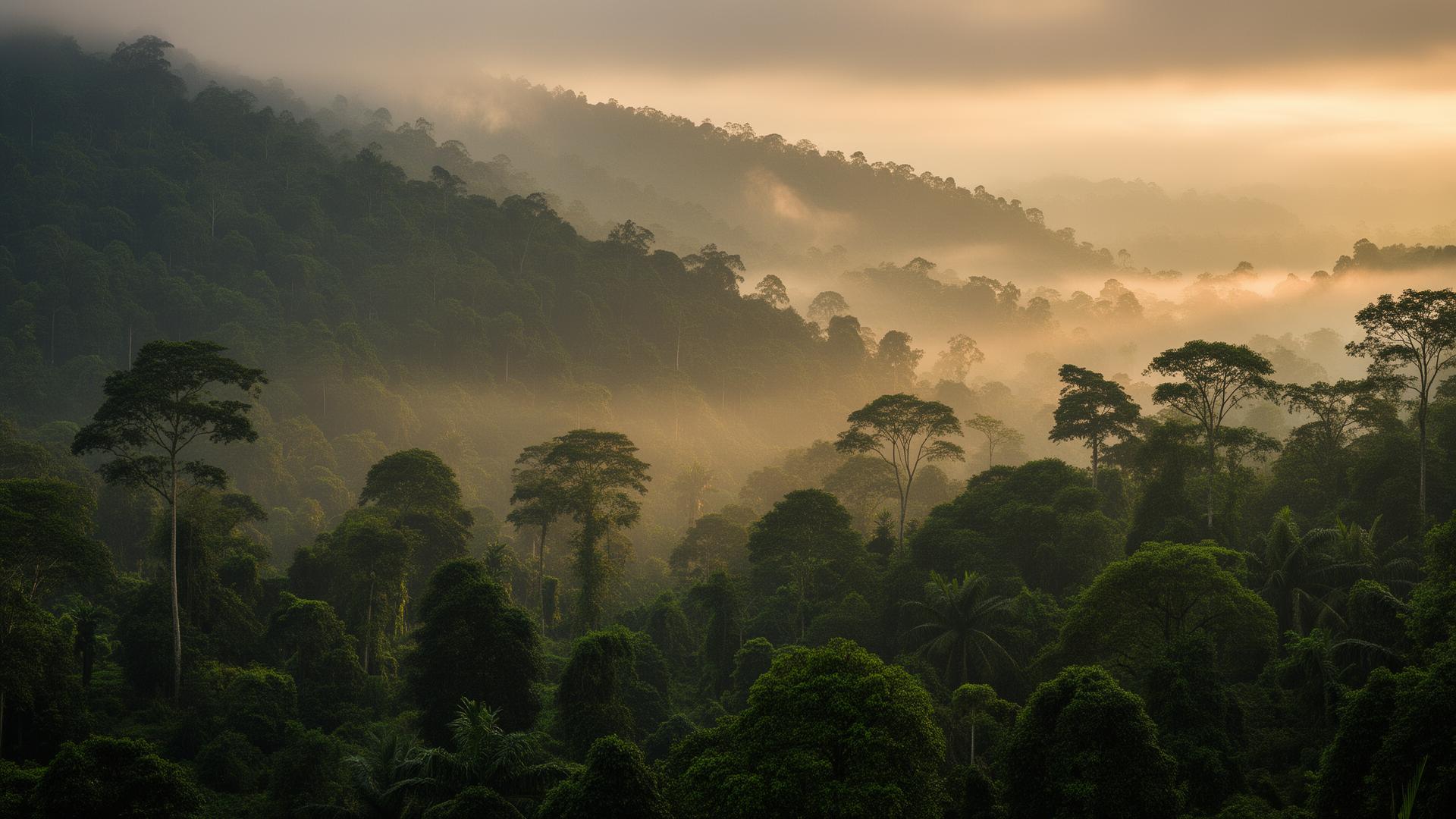
Every intentional community is shaped by its place as much as by its people. The land determines the food, the food shapes the daily rhythm, the rhythm forms the culture. So the question of where is not secondary to who — it is inseparable from it.
The spiritual context
Indonesia is home to more people who pray five times a day than any country on earth. This changes daily life in the specific: the adhan sounds as a matter of course. Halal food is the norm. The Friday prayer is a social institution. The rhythm of life follows the rhythm of faith.
Many practices that once required intentional effort — finding halal food, locating a masjid, navigating a calendar built around different rhythms — become part of the surrounding social fabric. What was effortful becomes more naturally integrated into everyday life.
The land and climate
Indonesia's highlands enjoy a climate that is warm without being punishing, green without being hostile. The volcanic soil is among the most fertile on earth. Its biodiversity is extraordinary — one of the most ecologically rich places on earth, much of it still genuinely intact.
For a permaculture food system, this is a gift. The layered food forest grows faster, produces more abundantly, and can become extraordinarily productive when designed and stewarded well.
The practical picture
- Cost of living — significantly lower than Western cities. A comfortable life costs a fraction of the equivalent in Europe or North America.
- Visa pathways — long-term options for retirees and remote workers, including visas of up to 10 years. Legal residency pathways are well-established.
- Healthcare — major cities have excellent international hospitals. Land criteria will include proximity to quality care, with a target of no more than 60–90 minutes from a city with international medical facilities.
- Language — Bahasa Indonesia is one of the most learnable languages in the world. Bahasa Indonesia is widely considered one of the more accessible languages for adults to learn conversationally — logical structure, consistent pronunciation, no tonal system.
- Connectivity — high-speed internet has expanded significantly across Indonesian highlands. Remote work is genuinely viable.
The cultural texture
Indonesia is an archipelago of 17,000 islands and over 300 distinct ethnic groups. What unites much of it is a culture of hospitality and the concept of gotong royong — mutual cooperation for the common good. This has been part of village life for centuries. Many of the values we are building around already exist within Indonesian village life. The gotong royong tradition is not something we are bringing — it is something we are joining.
We are not escaping to Indonesia. We are arriving somewhere where many of the cultural instincts we value still remain alive — in village life, in the rhythms of the land, in the social fabric of communities that have not yet been fully unwoven.
A note on reciprocity
This project will only succeed if it grows in respectful relationship with the people, traditions, ecology, and laws of Indonesia itself. We are not seeking isolation from the country — but participation within it. As long-term neighbours and contributors, not as people who have arrived to build a better world in someone else's backyard.
The gotong royong spirit, the ecological knowledge held in local farming communities, the legal structures that govern land and residence — all of these deserve genuine engagement, not just compliance. We are guests until we have earned something more. That orientation shapes everything about how we intend to build.
What we don't yet know
We have not identified the specific site. That is deliberate — the Seed Circle shapes the land criteria together before any commitment is made. Climate, proximity to a city, ecological integrity, access to water. The specific valley, the specific view from the masjid door on a foggy morning — those details will be chosen together. But Indonesia is where they will be.