The dream is real and worth taking seriously. Fresh food grown by hands you know. A slower pace. A place where your children run between neighbours' houses and come home at dusk. A community that shares your values. A life that feels like it is being lived rather than managed.
This is not a niche aspiration. It is one of the oldest human longings — and in the modern world it has become acute. The disconnection from land, from community, and from the deeper rhythms of life is not imaginary. It is felt daily, in cities and suburbs around the world, by families who have everything and still sense something essential is missing.
Something is shifting. The model of isolated ownership — one family, one plot, one set of problems to solve alone — is quietly failing the people who try it. What is replacing it, slowly and in different forms around the world, is something older than ownership itself: the collaborative ecosystem. People choosing to hold things in common, govern together, and build something none of them could sustain alone.
This is not a new idea dressed in modern language. It is a return. And most people trying to find their way back to it end up trying one of two paths first.
Path one: own land individually
It begins with a deposit and a dream. You find land — a few acres, maybe more. You imagine the garden, the chickens, the fruit trees. You picture your family learning to grow food, the children barefoot in the soil, the slower pace of life.
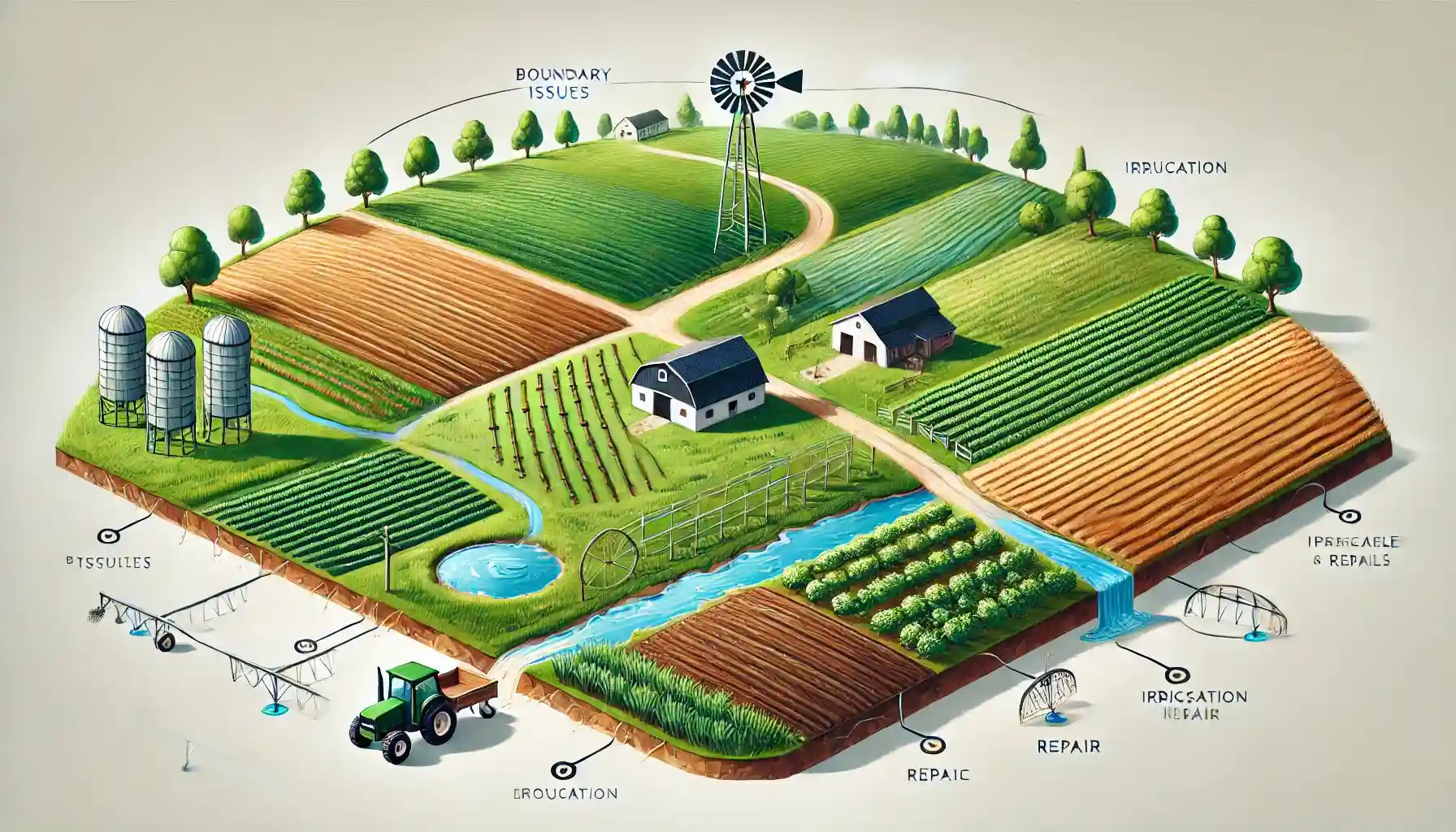
What arrives instead: the maintenance burden. The boundary disputes with neighbouring plots. The irrigation system that breaks during the one week you need it most. The specialist knowledge you don't have and can't afford to hire. The caretaker's number on speed dial because you cannot be there full time. The loneliness — because the village, the jamaah, the intergenerational life you imagined — none of it arrived with the land title.
The children who were going to grow up barefoot in soil spend weekends staring at screens in a farmhouse no one quite lives in.
For many families, the economics become difficult surprisingly quickly. Small-scale farming without shared infrastructure, ecological design, or the knowledge that accumulates over generations is far harder than most people initially expect. The community has to be built separately from the land — and it rarely is.
Path two: a farmhouse in a gated project
The gated farmhouse project solves the maintenance problem. Someone else runs the farm. Someone else handles the irrigation and the repairs and the caretaking. You buy a unit, you visit on weekends, you eat the produce that appears in a basket by your door.
What you don't get: roots. The farm is a backdrop, not a relationship. The neighbours are other weekend visitors, not a community. The experience is aesthetic rather than deeply relational — natural materials, open spaces, greenery — observed rather than inhabited. You have a second address. You do not have a second life. The masjid is rarely central. The jamaah doesn't form. The children don't grow up here — they visit here.
Both paths fail for the same underlying reason, expressed differently. Individual land ownership gives you the responsibility without the community. The gated farmhouse gives you the aesthetics without the substance. Both are attempts to buy something that cannot be purchased — the feeling of belonging to a place and a people.
You can't solve a problem using the same methods that created it. The disconnection from land and community is a product of individual, passive, managed living. Trying to fix it through individual, passive, managed land ownership doesn't resolve the problem. It repackages it.
The third way — an old model, adapted for now
There is a third option that most people don't know exists, because it has not been widely offered in the modern world. It is not a compromise between the first two. It is something qualitatively different — an approach that delivers what both alternatives were trying to achieve, by doing something neither of them does.
A group of committed families pool resources to acquire and steward a large landscape — 100+ acres — that none could hold meaningfully alone. The land is organised around three interdependent landscapes: 50% protected ecosystems, 25% food forest and farm, and 25% homes and community.
These proportions are illustrative and will be shaped by the ecological realities of the land the Seed Circle selects.
People repairing irrigation together on a Saturday morning. Children moving between homes without knocking because they know every door. Someone teaching Qur'ān under a tree while another tends the seedlings nearby. An evening meal that started as four people and became twelve.
Every member contributes equally. Every member governs equally. Every member eats from the same farm. Every member prays in the same masjid. The community is not a feature of the land. It is the land's purpose.
How the collective delivers what both alternatives couldn't
Why this model has deep roots
The collective is not a modern invention. The jamaah, the shared land, the covenant, the Muzara'ah contract for shared farming — these are among the time-tested ways of organizing life together — drawn from the tradition we are building from. The Prophet ﷺ practiced sharecropping at Khaybar. Village communities across the Muslim world farmed collectively for centuries. The gotong royong tradition in Indonesia — mutual cooperation for the common good — is still alive in village culture today.
What is new is not the idea. What is new is applying it deliberately, with modern legal structures, ecological design principles, and a founding covenant written by the members themselves — to a world that has lost the village and needs to rebuild it.
The collective is that rebuilding. Not a retreat from modern life. Not a nostalgic fantasy. A deliberately designed community, built people-first, rooted in values that have sustained human flourishing for centuries.
The Seed Circle is forming. The land has not yet been identified. What exists right now is the community — in its conversations, its commitments, and its covenant-in-progress. The people who join now are not buying into something finished. They are building the third way together. Communities like this are shaped through participation from the beginning.